
Introduction
An online advertising platform allows us to promote our products or services across search engines, websites, mobile apps, and social media. Today, businesses depend heavily on digital advertising platforms because they offer precision targeting, real-time tracking, and measurable performance.
Unlike traditional marketing, web advertising gives us control over budget, audience segmentation, bidding strategy, and optimization. We can launch campaigns quickly, test performance, and scale what works.
As competition increases in website advertising, businesses must focus on strategy, data, and continuous improvement. When we understand how an online ads platform works, we build predictable growth instead of depending on random traffic.
The Role of Targeting and Segmentation in Online Advertising
Targeting is the foundation of profitable website advertising.
Keyword Targeting
Search-based web advertising depends on selecting relevant keywords.
Long-tail keywords improve precision and reduce competition. For example, targeting “best digital advertising platforms for small business” attracts more qualified users than broad keywords.
Audience Segmentation
We divide audiences based on demographics, behavior, location, device usage, and interests.
Segmentation improves engagement and increases conversion potential because ads become more relevant.
Retargeting Strategy
Retargeting focuses on users who previously interacted with our website.
It increases brand recall, strengthens trust, and improves conversion probability. Many website marketing companies rely on remarketing campaigns to scale results effectively.
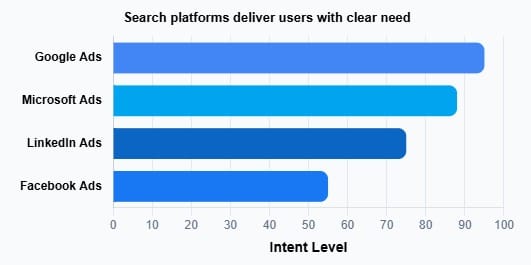
The graph compares intent levels across different advertising platforms. Google Ads and Microsoft Ads show the highest user intent because people actively search for products or services there. LinkedIn and Facebook Ads have lower intent since users are mainly browsing, making them better for awareness rather than direct conversions.
Digital Advertising Platforms for Targeted Business Growth
Advertising platforms allow us to expand reach by targeting users similar to existing customers.
This helps grow audience size while maintaining relevance and efficiency.
Overview of Major Online Advertising Platforms and Their Features
Different digital advertising platforms serve different marketing goals. The right choice depends on the business model, audience intent, and budget flexibility.
1. Google Ads – High Intent Search Advertising
Google Ads helps us reach people at the exact moment they are looking for answers, products, or services online. Instead of showing ads randomly, it connects our business with users who already have a clear need. Because of this strong search intent
Core Features
- Search ads based on keywords
- Display advertising network
- YouTube video ads
- Shopping ads for eCommerce
- Advanced conversion tracking
For example, when users search for service-based keywords, ads appear at the top of the results.
Benefits include high purchase intent, massive search volume, and detailed analytics.
2. Facebook Ads: Advanced Interest Targeting
Facebook Ads focuses on audience behavior, interests, and engagement patterns. It allows us to target users based on what they like, what they interact with, and how they behave online. This makes it one of the most powerful digital advertising platforms for brand awareness, lead generation, and retargeting campaigns.
Core Features
- Interest targeting
- Custom audiences
- Lookalike audiences
- Image and video ads
- Lead generation campaigns
For instance, brands targeting lifestyle products benefit from visual campaigns.
It allows flexible budgets and strong audience segmentation.
3. LinkedIn Ads: Professional Audience Reach
LinkedIn Ads allows us to connect directly with professionals, business owners, and decision-makers. It is especially powerful for B2B campaigns because we can target users based on job title, industry, company size, and professional interests.
Core Features
- Job title targeting
- Industry targeting
- Company size filters
- Sponsored posts
- Lead form ads
For example, enterprise service providers can directly reach decision-makers.
It is highly effective for professional networking and industry-specific outreach.
4. Microsoft Advertising: Search Alternative with Lower Competition
Microsoft Advertising reaches Bing users and offers competitive cost advantages.
It supports search, display, and shopping campaigns similar to other major web advertising companies. Many businesses use it to diversify traffic sources and reduce dependency on a single online ads platform.
Measuring Success Through Key Performance Indicators
Tracking performance helps us understand whether our campaigns on a digital advertising platform are actually delivering results. When we monitor the right metrics, we make smarter decisions, improve efficiency, and protect our budget.
Clear measurement ensures that our web advertising efforts remain profitable, scalable, and aligned with business goals.
It also helps us identify which ads, audiences, and keywords generate the highest return. By consistently analyzing performance data, we can optimize campaigns and strengthen long-term growth through smarter website advertising strategies.
- Click-Through Rate
- Cost Per Click
- Conversion Rate
- Cost Per Acquisition
- Return on Ad Spend
Conclusion
An online advertising platform gives us measurable control over business growth. When we combine strategic targeting, semantic keyword coverage, competitor gap analysis, and continuous optimization, digital advertising platforms become reliable revenue engines.
Success in web advertising depends on clarity, testing, data analysis, and consistent improvement. When we apply these principles properly, we create sustainable and scalable online growth.
As competition continues to increase in website advertising, businesses that focus on data-driven decisions and audience precision will achieve stronger long-term results
FAQs
1. What is an online advertising platform?
Ans. An online advertising platform is a system that allows businesses to create, manage, and optimize paid campaigns across search engines, social media, and websites.
2. Which digital advertising platforms are best for small businesses?
Ans. Google Ads and Facebook Ads are widely used because they allow flexible budgets and detailed targeting.
3. How does web advertising work?
Ans. Web advertising displays paid ads to users based on keywords, interests, demographics, and online behavior.
4. How do digital advertising platforms target the right audience?
Ans. Digital advertising platforms use data such as keywords, user interests, online behavior, location, and demographics to show ads to the most relevant audience.
5. How do website marketing companies improve campaign performance?
Ans. They refine targeting, optimize bidding strategies, improve landing pages, and continuously test campaigns to increase ROI.