
“My content is indexed… but Google still refuses to rank it.”
Honestly, this has become one of the biggest SEO frustrations recently. Many website owners are publishing more content than ever, yet rankings barely budge. Impressions stay low. Traffic feels invisible. And eventually the question shows up:
“Why is Google not ranking my content even after writing so much?”
In many cases, the issue is not backlinks or domain age.
It’s content quality.
Google’s ranking systems in 2026 have become much stricter about the following:
- usefulness,
- originality,
- topical relevance,
- user satisfaction,
- and experience-based information.
Thin, repetitive, AI-heavy, or surface-level pages now struggle badly, especially after Google’s Helpful Content updates and AI Overview expansion.
And honestly, I’ve seen this happen even on websites with decent authority.
The content technically exists… But it doesn’t give Google enough confidence to rank it prominently.
That’s the real problem behind most low-quality content SEO issues today.
What Google Actually Considers “Low-Quality Content”
A lot of people think low-quality content simply means the following:
- bad grammar,
- short articles,
- or missing keywords.
But modern Google systems now evaluate much deeper signals.
Low-quality content often looks like this:
- generic explanations copied from other blogs,
- AI-generated paragraphs with no experience,
- weak search intent matching,
- repetitive wording,
- outdated information,
- thin answers,
- or pages created only to target keywords.
Sometimes the content is not technically “wrong”…
It’s just forgettable.
That’s something many websites struggle with now.
Why Google Is Not Ranking My Content
Usually, it comes down to one of these problems:
| Problem | What Happens |
| Weak search intent match | Users leave quickly |
| Thin content | Google sees low value |
| Generic AI-style writing | Poor differentiation |
| No topical authority | Competitors look stronger |
| Poor structure | Hard to scan/read |
| Outdated information | Feels less trustworthy |
| No experience signals | Weak E-E-A-T |
While content quality is the primary factor, some quality backlinks still help signal authority to Google. Focus on content first, then build natural links over time.
And honestly, Google has become much better at identifying pages created mainly “to rank” rather than genuinely help users.
That shift became even more noticeable after recent AI-driven search changes.
How to Identify Low-Quality Content on Your Website
Before fixing content, first identify which pages are underperforming.
Check Google Search Console
Go to:
Performance → Search Results
Look for pages with:
- low impressions,
- poor average position,
- very low CTR,
- or declining clicks.
These pages often indicate:
- weak relevance,
- poor search intent alignment,
- or content quality issues.
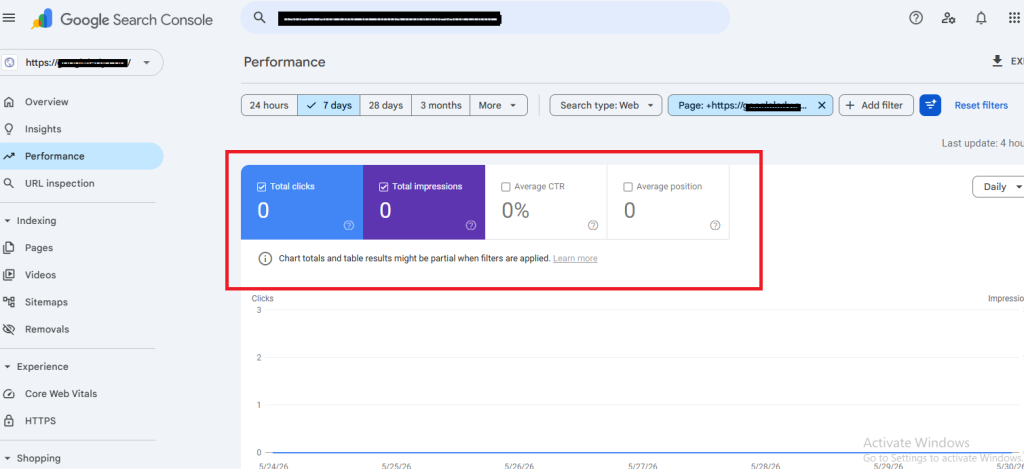
These real screenshots help readers understand what weak-performing pages actually look like inside SEO tools.
Look for Pages With High Bounce Signals
If users:
- click,
- skim briefly,
- then leave quickly.
Google may interpret that as weak satisfaction.
This doesn’t mean bounce rate alone is a ranking factor…
…but poor engagement patterns usually signal a deeper problem.
Compare Your Content With Top Results
Search for your target keyword manually.
Then ask:
- Does my article answer the query faster?
- Is it more useful?
- Does it feel more trustworthy?
- Does it include real examples?
- Would I personally save or share this page?
Honestly, that last question reveals a lot.
Technical SEO Issues That Quietly Hurt Rankings
Sometimes the content itself is not the only issue.
Even genuinely helpful content can struggle if technical SEO problems confuse Google’s crawling or indexing systems.
Check the following:
- Check if pages are marked “Crawled – currently not indexed” in Google Search Console
- Ensure no noindex tags or robots.txt blocking on important pages
- Verify Core Web Vitals and page load speed using PageSpeed Insights
- Submit and validate your sitemap structure
- Clean up parameter URLs causing index bloat
- Add internal links pointing to underperforming content
How to Improve Content Quality for SEO
This is where most websites either recover…
Or continue struggling.
Typically, content improvements show results in 2–8 weeks after fixes. Be patient and monitor Google Search Console for gradual changes.
Let’s make it practical.
1. Fix Search Intent First
This is the biggest issue on many websites.
Example:
Someone searches:
“How to improve content quality for SEO”
But the article mostly discusses the following:
- backlink building,
- technical SEO,
- or keyword tools.
That’s an intent mismatch.
Users wanted:
- content improvement steps,
- quality signals,
- readability fixes,
- Practical optimisation advice.
Google increasingly rewards pages that solve the exact problem users searched for.
If your site has lower domain authority, target long-tail keywords first. They’re less competitive and easier to rank while you build topical authority.
2. Add Real Experience & Observations
This matters much more now.
Google’s helpful content systems increasingly favour:
- practical insights,
- real examples,
- lived experience,
- and person-first writing.
Honestly, many AI-generated articles fail because they sound emotionally flat.
They explain topics… But never feel experienced.
Even small observations help.
Example:
“I’ve seen pages improve rankings simply after rewriting generic introductions and adding clearer examples.”
That human layer changes how content feels.
3. Remove Thin & Repetitive Sections
A lot of low-quality content becomes bloated with:
- filler sentences,
- repeated explanations,
- keyword repetition,
- and unnecessary fluff.
Modern SEO writing performs better when:
- clearer,
- tighter,
- and more purposeful.
Sometimes deleting weak sections improves rankings more than adding new words.
4. Improve Structure & Readability
Google increasingly favors content that is
- easy to scan,
- mobile-friendly,
- visually organised,
- and simple to understand.
Use:
- short paragraphs,
- descriptive headings,
- bullet points,
- comparison tables,
- and FAQ sections.
LLMs and AI Overviews also extract information more easily from structured content.
5. Add Helpful Depth, Not Just Length
Longer articles do not automatically rank better.
This is something many websites misunderstand.
Google looks for:
- completeness,
- usefulness,
- topical coverage,
- and clarity.
Not random word count inflation.
A focused 1,500-word article can outperform a weak 4,000-word page easily.
6. Update Outdated Content
Old content often loses rankings slowly over time.
Especially in:
- SEO,
- AI,
- digital marketing,
- and technology topics.
Update:
- examples,
- statistics,
- screenshots,
- references,
- and search trends.
Freshness still heavily influences trust and engagement.
Tools That Help Improve Content Quality
Google Search Console
Track impressions, average position, CTR, indexing issues, and underperforming pages.
PageSpeed Insights
Useful for checking mobile performance, Core Web Vitals, loading speed, and usability issues.
Ahrefs / SEMrush
Helpful for: competitor analysis, keyword gaps, backlink analysis, and content audits.
RivalFlow AI
Useful for: AI-powered content auditing, topical coverage analysis, and identifying weak content areas.
Real Example: Why One Article Failed to Rank
I once reviewed a blog post targeting “SEO content optimisation.
The article had:
- decent length,
- keywords,
- And okay formatting.
- But rankings stayed terrible.
Why?
Because the content sounded like every other SEO article online.
- It repeated:
- generic advice,
- obvious tips,
- and textbook explanations.
We improved it by:
- adding real examples,
- simplifying explanations,
- restructuring headings,
- And matching search intent more clearly.
Within a few weeks:
- Impressions improved,
- Rankings started climbing.
- And CTR increased too.
Interestingly, we barely changed backlinks.
The issue was content usefulness.
Signs Your Content Might Feel “Low Quality” to Google
It Sounds Generic
If users could replace your brand name with another site and nothing changes…
The content probably lacks originality.
It targets keywords more than users.
Pages written mainly for keyword placement usually feel unnatural now.
Google increasingly recognises this pattern.
It Avoids Specific Examples
Specificity builds trust.
Generic advice rarely stands out anymore.
It Doesn’t Fully Answer the Query
This happens constantly.
A page may mention the topic… but never clearly solve the actual problem.
That hurts rankings badly.
Content Quality Checklist for Better Rankings
Before publishing, check this:
✔ Does the article match search intent clearly?
✔ Does it answer the query quickly?
✔ Are headings easy to scan?
✔ Does it include real examples or observations?
✔ Is the content genuinely useful?
✔ Does it avoid fluff and repetition?
✔ Is the information updated for 2026?
✔ Would a real user actually bookmark or share this?
Honestly, that final question matters more than many SEO tricks.
AI Overviews Are Changing Content Standards
This is important now.
Google AI Overviews often summarise:
- direct answers,
- concise explanations,
- structured insights,
- and trustworthy sources.
That means low-value filler content struggles even more today.
Pages that perform better usually:
- answer quickly,
- structure information clearly,
- provide practical expertise,
- And feel genuinely human.
This shift is changing SEO writing completely.
Internal Linking Suggestions
You can internally connect this article with:
- content optimisation guides,
- technical SEO tutorials,
- Google Search Console articles,
- organic traffic recovery posts,
- Search intent strategy blogs.
Suggested anchors:
- “Improving content quality”
- “Why websites lose rankings”
- “Google Search Console analysis”
- “Recovering organic traffic”
Schema Opportunities
This article works well with:
- FAQ schema,
- Article schema,
- HowTo schema.
Structured data helps:
- AI extraction,
- rich results,
- and topical understanding.
About the Author
Shashi, director at Oxygen, has worked closely with businesses struggling with low rankings, weak content performance, and SEO visibility issues. Through practical SEO optimisation and content quality improvements, he has helped websites recover lost impressions, improve rankings, and build stronger organic topical authority.
Frequently Asked Questions
Why is Google not ranking my content?
Usually because the content lacks strong alignment with search intent, originality, depth, or user-focused helpfulness. Generic or repetitive pages often struggle to rank today.
What is low-quality content in SEO?
Low-quality SEO content often includes thin explanations, keyword stuffing, outdated information, repetitive wording, or content created primarily for rankings rather than users.
How to improve content quality for SEO?
Focus on search intent, clearer structure, practical examples, updated information, and genuinely useful explanations. Experience-based writing also helps significantly.
Can AI-generated content rank on Google?
Yes, but only if it provides genuine value, originality, and strong usefulness. Thin AI-generated filler content often struggles after helpful content updates.
Does updating old content improve rankings?
Yes, especially when you improve accuracy, freshness, search intent alignment, and overall usefulness. Content updates often help recover lost visibility.
Conclusion
If your content isn’t ranking, publishing more articles isn’t usually the solution.
In many cases, the better move is improving usefulness, clarity, originality, and real user value.
Modern SEO is no longer just about inserting keywords into long articles.
Google increasingly rewards content that:
solves problems clearly,
feels genuinely helpful,
and reflects real understanding of the topic.
That’s what stronger rankings are built on now in 2026.