
Introduction
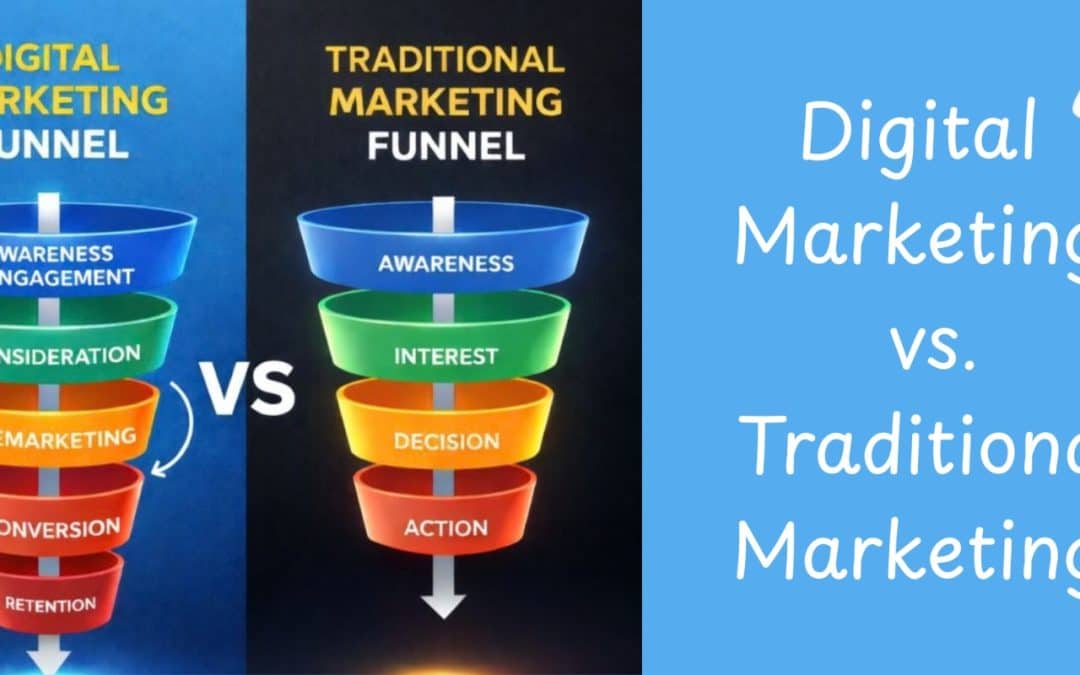
Marketing is how businesses communicate with customers. Today we see two major approaches: online promotion and offline promotion. When we compare digital marketing vs. traditional marketing, we notice that both methods try to reach customers, build trust, and increase sales, but they use different channels and strategies.
When we carefully observe the digital marketing and traditional marketing differences, we understand that each method has unique advantages.
In this article, we explore how both strategies work, where they are used, and how businesses combine them to achieve better results.
Defining Digital Marketing
Digital marketing means promoting products or services online, using tools like search engines, social media, websites, and email. These internet-based tools help businesses reach people and build relationships with new customers.
Companies use techniques like SEO, content marketing, and social media campaigns to reach people who are actively searching for solutions.
Another important benefit is targeting. Businesses can show advertisements to a specific audience based on location, interests, or behavior. This makes campaigns more effective and measurable because companies can track clicks, engagement, and conversions.
For example, a small clothing brand might write helpful fashion blogs and share them on social media. When people look for style tips, they discover the brand and get interested in its products.
Common Online Marketing Channels
- Search engine optimization
- Social media campaigns
- Email newsletters
- Content marketing
- Online advertisements
These methods help businesses connect with audiences across the world.
Exploring Traditional Marketing
Traditional marketing focuses on offline promotional methods that existed long before the internet. Businesses use channels such as television, radio, newspapers, magazines, billboards, and printed materials.
These traditional methods often cost more because of production, printing, or broadcast fees. It’s also harder to measure results, since companies can’t easily track how many people respond to an ad.
For instance, a restaurant might place a large billboard on a busy road to attract local customers. People who pass by the location repeatedly remember the brand and eventually decide to visit.
Common Offline Marketing Channels
- Television advertisements
- Radio promotions
- Newspaper advertisements
- Flyers and brochures
- Outdoor billboards
These methods focus mainly on local audiences and mass visibility.
Core Differences and Methodological Contrasts in Marketing Approaches
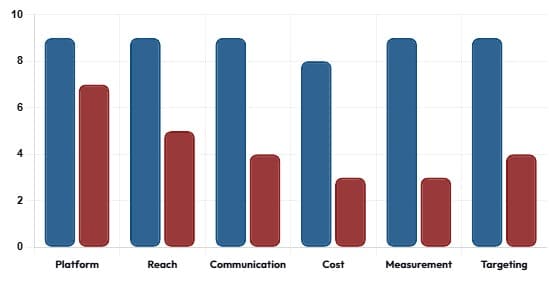
| Aspect | Digital Marketing | Traditional Marketing |
| Platform | Uses online platforms like websites, social media, and search engines. | Uses offline media like TV, radio, newspapers, and billboards. |
| Reach | Can reach a global audience through the internet. | Mostly targets local or regional audiences. |
| Communication | Allows two-way interaction with customers. | Mainly one-way communication. |
| Cost | More cost-effective and flexible. | Usually more expensive. |
| Measurement | Results can be tracked using analytics. | Difficult to measure exact results. |
| Targeting | Allows precise audience targeting. | Targets a broad audience. |
Conclusion
Marketing keeps changing as technology grows. Comparing digital and traditional marketing shows that each serves a different purpose.
Online promotion focuses on targeted communication, real-time analytics, and global reach. Offline promotion focuses on brand visibility, mass awareness, and a strong local presence.
The best approach isn’t picking just one method. Instead, businesses get the most out of marketing by combining both, building trust, attracting customers, and growing over time.
FAQs
1. What is the difference between digital marketing and traditional marketing?
Ans. Digital marketing uses online channels such as search engines, websites, and social media, while traditional marketing relies on offline channels like television, radio, newspapers, and billboards.
2. Why is digital marketing important for businesses today?
Ans. Digital marketing is important because it helps businesses reach a global audience, target specific customer groups, and track campaign performance through analytics. It also allows companies to interact directly with customers through online platforms.
3. What are some examples of traditional marketing?
Ans. Examples of traditional marketing include television advertisements, radio promotions, newspaper ads, magazine advertisements, flyers, brochures, and outdoor billboards that promote products to a large audience.
4. Can businesses use digital marketing and traditional marketing together?
Ans. A company may advertise on television while also running social media campaigns and search engine advertisements to reach more customers.
5. Which marketing strategy is better for small businesses?
Ans. Digital marketing is often more suitable for small businesses because it is cost-effective and allows precise audience targeting. However, traditional marketing can still be useful for building local brand awareness in specific areas.